ConnectApprovedKnowledgetoReviewableAI.
Build access-filtered retrieval over agreed sources. Evaluate answer support, citations, missing knowledge and refusal behavior before a production release.
Choose Retrieval, Context or Fine-Tuning
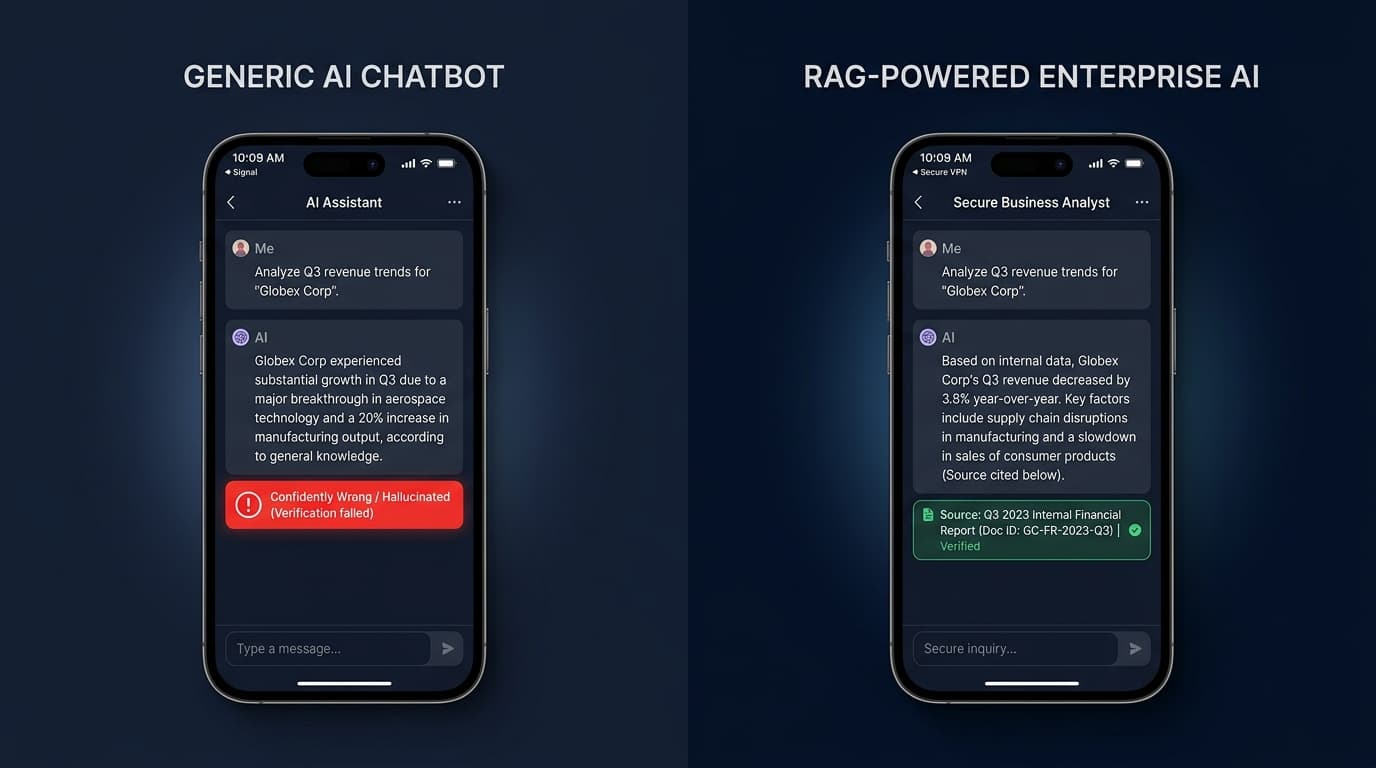
Three approaches with different tradeoffs. These are design considerations, not provider rankings or guarantees; evaluate the actual configuration on your own test set.
Direct Prompt Context
- ✕Provide selected policy context
- ✕Incorrect answers remain possible
- ✕Review actual data-processing terms
- ✕Test source support explicitly
- ✕Check input and output limits
Retrieval-Augmented Workflow
- ✓Index only approved source scope
- ✓Evaluate citations against source text
- ✓Filter retrieval by user permission
- ✓Validate retention and deletion rules
- ✓Measure retrieval gaps and latency
Fine-Tuning Alone
- !Needs a justified training objective
- !Requires a model update plan
- !Live sources need separate integration
- !Needs suitable rights-cleared examples
- !Still needs grounding and evaluation
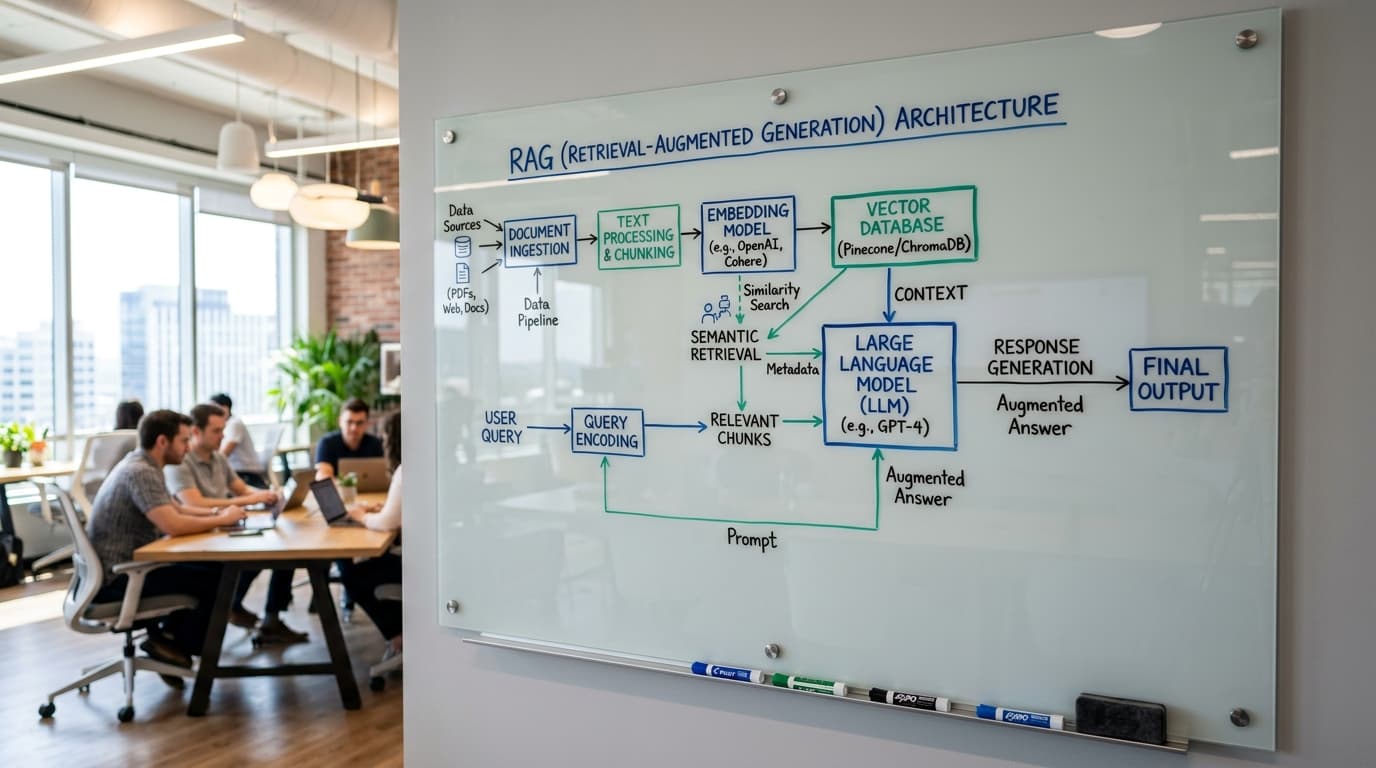
How We Make AI Know Your Business
The standard Retrieval-Augmented Generation (RAG) flow, explained simply.
INGEST
Inventory permitted sources, parse their content and test chunk sizes. Preserve access rules, deletion handling and source versions during ingestion.
EMBED
Index selected content with source metadata and permissions. Evaluate retrieval coverage and refresh behavior before choosing the storage configuration.
ANSWER
Retrieve candidate passages for an authorized question. Generate a draft using approved the retrieved evidence; check citation support and refuse or escalate missing evidence.
Your Data Privacy Is Our Non-Negotiable
Confirm actual data flows, contractual terms and access controls for the selected architecture.
Which data may leave your environment?
Map prompts, retrieved passages, logs and backups. Confirm authorization, contractual terms, region, retention and deletion before sending confidential data.
What needs checking for a hosted service?
Review the selected service and account configuration, subprocessors, training terms, access controls and incident responsibilities; product names alone do not establish privacy.
What changes with self-hosting?
Evaluate licensing, hardware, patching, telemetry and operational access. Self-hosting still needs isolation tests and a named infrastructure owner.
Agree the Boundary:
Document data flows, identity checks, permissions and evidence requirements. Legal/compliance review and certification are separate responsibilities, not implied by this service.
Evaluate the Deployment and Workflow
Design options, not current model rankings or price quotes. Benchmark selected versions on agreed tasks and review provider terms at procurement; no universal winner is claimed.
Hosted API
Evaluate task quality and integration effort
Managed Platform
Assess identity, region and operational controls
Self-Hosted
Compare hardware, licensing and maintenance
Compact Model
Test a bounded task within resource limits
Fallback Route
Test safe degradation, spend and quality changes
Human Review
Escalate missing evidence and sensitive decisions
The Modern AI Stack
Frameworks
- LangChain
- LlamaIndex
- Semantic Kernel
- DSPy
- AutoGen
Vector Databases
- Pinecone
- Weaviate
- Qdrant
- pgvector
- Chroma
- Milvus
LLM APIs
- OpenAI API
- Anthropic API
- Google AI Studio
- AWS Bedrock
- Azure OpenAI
- Ollama
Data Processing
- LangChain loaders
- Unstructured.io
- PyPDF2
- Apache Tika
Infrastructure
- FastAPI
- Docker
- Kubernetes
- AWS Lambda
- Vercel
Our Technical Integration Process
Handover source mappings, evaluation cases, runbooks and ownership. Production release requires agreed acceptance criteria.
Data Audit & Schema Mapping
We analyze your internal data sources (SQL, PDFs, Confluence) to determine cleanliness, access controls, and structure.
Chunking Strategy & Embedding Selection
Compare chunking and embedding candidates on representative questions, languages and source formats.
Vector Database Setup & Indexing
Implement scoped indexing, permission filters, source updates and deletion propagation; test failure recovery.
LLM Integration & Prompt Engineering
Build a versioned retrieval API with citation checks, output validation, refusal paths and bounded retries.
Evaluation & Release Review
Evaluate retrieval relevance, supported answers, refusal quality, leakage tests, latency and task cost; include expert review.
Design sample — illustrative quote and attribution, not verified client feedback.
"A useful knowledge assistant would show its sources, respect access permissions and admit when the available documents do not support an answer."

Frequently Asked Questions
Scope a Retrieval Pilot With Your Data.
Source readiness, evaluation and access checks determine milestones. Review quality before release.